
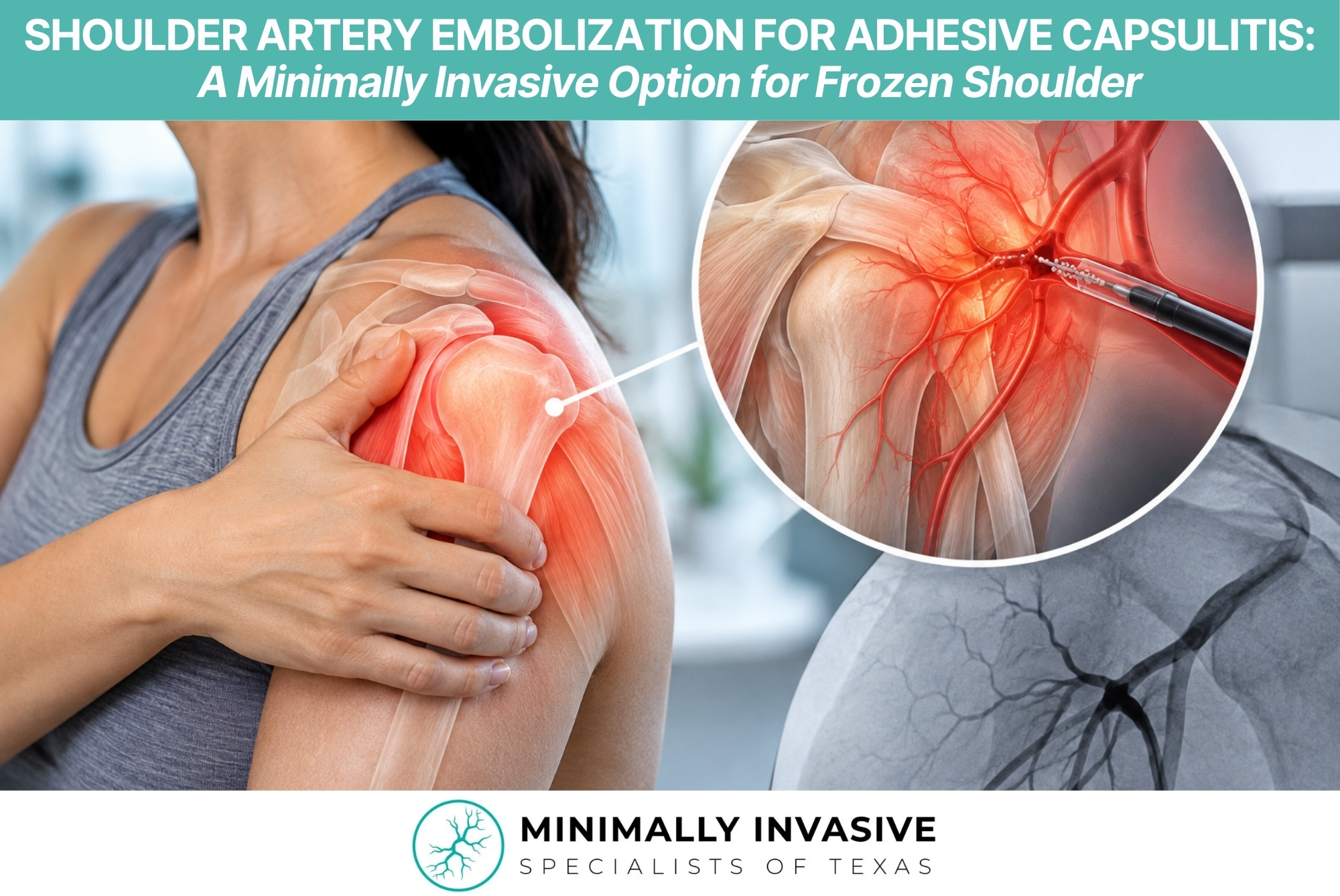
Adhesive capsulitis, commonly called frozen shoulder, can cause persistent pain, progressive stiffness, and significant loss of shoulder mobility. Everyday activities such as reaching overhead, putting on a shirt, fastening a seat belt, washing your hair, or sleeping on the affected side can become uncomfortable or difficult. Although many cases eventually improve with conservative treatment, some patients continue to experience significant symptoms despite physical therapy, medications, injections, and other therapies.
For appropriately selected patients, shoulder artery embolization (SAE) represents an emerging minimally invasive treatment option. The procedure targets abnormal blood vessels associated with inflammation and pain around the shoulder without requiring open surgery.
At Minimally Invasive Specialists of Texas, patients with persistent musculoskeletal pain can be evaluated to determine whether an image-guided, minimally invasive treatment may be appropriate. Understanding how shoulder artery embolization works, why abnormal blood vessels may contribute to adhesive capsulitis, and what patients can expect from treatment can make it easier to explore available options.
What Is Adhesive Capsulitis?
Understanding Frozen Shoulder
Adhesive capsulitis is a painful condition involving the capsule surrounding the shoulder joint. This connective tissue normally provides enough flexibility for the shoulder’s extensive range of motion. With adhesive capsulitis, the capsule becomes inflamed, thickened, and contracted.
As the condition progresses, patients typically experience both pain and restricted movement. A defining characteristic is limitation of both active range of motion, when the patient moves the shoulder independently, and passive range of motion, when the shoulder is moved by someone else.
The loss of motion can be especially noticeable during external rotation, overhead movement, and activities that require reaching behind the back.
What Are the Symptoms of Adhesive Capsulitis?
Frozen shoulder symptoms commonly include persistent shoulder pain, stiffness, limited range of motion, nighttime pain, difficulty sleeping on the affected side, and discomfort with reaching or rotational movements.
The condition can interfere with dressing, bathing, driving, exercising, household activities, and occupational responsibilities.
Symptoms typically develop gradually rather than appearing all at once.
What Causes Frozen Shoulder?
The exact mechanisms responsible for adhesive capsulitis are complex. The condition involves inflammation followed by fibrosis and tightening of the joint capsule.
Researchers have also investigated the role of increased and abnormal blood vessel formation, known as neovascularization, in painful musculoskeletal conditions. These abnormal vascular networks may contribute to persistent inflammatory activity and pain signaling.
Who Is at Greater Risk for Adhesive Capsulitis?
Frozen shoulder is most frequently seen in middle-aged and older adults. Certain medical conditions are associated with an increased risk, including diabetes and thyroid disorders.
Adhesive capsulitis can also develop following shoulder surgery, injury, or prolonged immobilization. In some patients, however, there is no identifiable cause.
A thorough evaluation is important because several other shoulder disorders can produce similar symptoms.
The Three Traditional Stages of Frozen Shoulder
Adhesive capsulitis is traditionally described as progressing through three stages, although individual experiences vary considerably.
The Freezing Stage
During the freezing stage, shoulder pain typically increases and range of motion gradually decreases. Nighttime pain can become particularly troublesome.
This stage can last for several months.
The Frozen Stage
During the frozen stage, pain may become less intense for some patients, but substantial stiffness remains. Activities requiring rotation or elevation of the arm may be especially difficult.
The Thawing Stage
During the thawing stage, shoulder mobility gradually begins to improve.
Although adhesive capsulitis can eventually resolve or substantially improve, the entire process may take many months and sometimes considerably longer. For patients experiencing persistent pain and disability, waiting for natural resolution can have a substantial effect on quality of life.
What Is Shoulder Artery Embolization?
Shoulder artery embolization is a minimally invasive, image-guided vascular procedure designed to selectively reduce abnormal blood flow associated with chronic inflammation and pain.
Instead of using a traditional surgical incision, an interventional specialist introduces a very small catheter into an artery through a tiny access site. Advanced imaging is then used to navigate through the arterial system and identify blood vessels supplying the symptomatic area of the shoulder.
When abnormal vascularity is identified and can be safely treated, embolic material is selectively delivered through the catheter.
The goal is not to eliminate normal circulation to the shoulder. Instead, the procedure targets specific abnormal vascular pathways while preserving healthy surrounding blood flow.
How Can Abnormal Blood Vessels Contribute to Frozen Shoulder Pain?
The Relationship Between Inflammation and Neovascularization
Chronic inflammation can stimulate angiogenesis, the formation of new blood vessels. In certain musculoskeletal conditions, these abnormal small vessels may develop in areas of ongoing inflammation.
New nerve fibers involved in pain signaling may accompany abnormal vascular growth. This relationship between inflammation, neovascularization, and pain has become an important area of research in interventional medicine.
How Embolization Targets the Inflammatory Process
During shoulder artery embolization, the physician uses angiography to identify abnormal patterns of blood flow associated with the symptomatic area.
By selectively decreasing flow through these vessels, embolization is intended to reduce inflammatory activity and pain signaling.
The goal is to interrupt part of the persistent inflammatory cycle rather than surgically altering the shoulder joint.
How Is Shoulder Artery Embolization Performed?
Shoulder artery embolization is generally performed as a minimally invasive procedure using sophisticated imaging technology.
Pre-Procedure Evaluation
Before recommending embolization, the physician evaluates the patient’s medical history, symptoms, physical examination findings, imaging studies, and previous treatments.
Confirming the diagnosis is essential because shoulder pain may also result from osteoarthritis, rotator cuff disease, bursitis, calcific tendinopathy, cervical spine disorders, or other musculoskeletal conditions.
Arterial Access
A small arterial access site is created, and a thin catheter is introduced into the vascular system.
The specific artery selected for access depends on individual anatomy and physician preference.
Angiography
Contrast material is introduced through the catheter while specialized X-ray imaging produces detailed pictures of the arteries around the shoulder.
The physician evaluates these images for abnormal vascular patterns that correspond with the patient’s symptoms.
Selective Embolization
A microcatheter can be advanced into specific arterial branches when appropriate. Embolic material is then carefully delivered to reduce abnormal blood flow.
This selective approach is an important distinction: the goal is to treat abnormal vessels associated with inflammation while protecting normal circulation and surrounding tissues.
Recovery and Discharge
Following the procedure, the catheter is removed and the arterial access site is managed according to the technique used.
Patients are monitored for an appropriate period before discharge. Many embolization procedures can be performed without an overnight hospital stay, although individual circumstances vary.
What Are the Potential Benefits of Shoulder Artery Embolization?
Minimally Invasive Treatment
Shoulder artery embolization is performed through a small arterial access point rather than a large surgical incision.
Targeted Treatment
Advanced angiographic imaging allows the physician to visualize and selectively target abnormal vascularity associated with the symptomatic shoulder.
Potential Reduction in Pain
Early research involving transarterial embolization for adhesive capsulitis and other musculoskeletal disorders has reported encouraging improvements in pain among appropriately selected patients.
However, research into SAE for adhesive capsulitis is still evolving, and results cannot be guaranteed.
Potential Improvement in Shoulder Function
Reducing pain may make it easier for patients to move the shoulder and participate in rehabilitation.
Embolization does not mechanically release a contracted shoulder capsule. Therefore, improving range of motion may still require stretching, exercise, physical therapy, and time.
Avoiding Major Surgery
For suitable patients, embolization may provide another treatment option before or instead of more invasive procedures. Treatment decisions should always be individualized according to the patient’s diagnosis, symptoms, previous treatment response, and overall health.
Who May Be a Candidate for Shoulder Artery Embolization?
Potential candidates may include patients with a confirmed diagnosis of adhesive capsulitis who continue to experience significant pain and functional limitations despite appropriate conservative treatment.
What Treatments Are Typically Tried Before SAE?
Initial frozen shoulder treatment may include activity modification, medications when medically appropriate, physical therapy, structured stretching, and corticosteroid injections.
Other interventions, such as hydrodilatation, manipulation under anesthesia, or arthroscopic capsular release, may be considered depending on symptom severity and response to treatment.
Shoulder artery embolization provides an additional minimally invasive option that may be considered for selected patients.
Why Is Patient Selection Important?
Not every patient with shoulder pain has adhesive capsulitis, and not every patient with adhesive capsulitis will be an appropriate candidate for embolization.
A comprehensive consultation allows the physician to determine whether symptoms are consistent with frozen shoulder and whether abnormal inflammatory vascularity may be an appropriate treatment target.
Shoulder Artery Embolization vs. Corticosteroid Injections
Corticosteroid injections are commonly used to decrease inflammation and pain associated with adhesive capsulitis, particularly during painful stages of the condition.
Shoulder artery embolization works through a different mechanism. Instead of injecting anti-inflammatory medication directly into or around the shoulder, embolization targets selected abnormal blood vessels associated with chronic inflammatory activity.
Neither treatment is universally superior. The appropriate option depends on the patient’s condition, previous treatments, symptom duration, medical history, and individual goals.
Shoulder Artery Embolization vs. Shoulder Surgery
Surgery and embolization are fundamentally different procedures.
Arthroscopic capsular release mechanically releases contracted portions of the shoulder capsule. Shoulder artery embolization does not cut or release the capsule. Instead, it addresses abnormal vascularity associated with inflammation and pain.
Patients with substantial mechanical restriction or other structural shoulder abnormalities may require different treatment.
The goal is not simply to choose the least invasive procedure, but to select the treatment most appropriate for the underlying cause of the patient’s symptoms.
Is Shoulder Artery Embolization an Established Treatment for Frozen Shoulder?
Musculoskeletal arterial embolization is an evolving field.
Clinical research has investigated transarterial embolization for several chronic musculoskeletal pain conditions, including adhesive capsulitis and knee osteoarthritis. Published studies have demonstrated promising results regarding pain and functional improvement in selected patients.
However, the evidence supporting SAE for adhesive capsulitis remains less extensive than the evidence supporting many established frozen shoulder treatments. Larger studies, longer follow-up periods, standardized techniques, and additional comparative research are needed.
Patients considering the procedure should receive a balanced discussion of potential benefits, risks, alternatives, and the evolving nature of the evidence.
What Are the Risks of Shoulder Artery Embolization?
All medical procedures carry potential risks.
Possible risks associated with arterial embolization can include bleeding or bruising at the catheter insertion site, blood vessel injury, infection, contrast reactions, temporary discomfort, and unintended embolization of healthy tissue.
Contrast material may require additional consideration in patients with certain kidney conditions or a history of contrast reactions.
Temporary skin changes or other localized effects may also occur depending on the vessels treated and embolic agent used.
A detailed consultation with Minimally Invasive Specialists of Texas can help patients understand risks specific to their medical history and proposed treatment.
What Is Recovery Like After Shoulder Artery Embolization?
Because shoulder artery embolization does not require a large surgical incision, recovery is generally different from recovery following traditional shoulder surgery.
Can Patients Go Home the Same Day?
Many patients undergoing minimally invasive arterial embolization can return home following a period of observation. The medical team provides specific instructions regarding the access site, medications, activity, and follow-up.
When Does Pain Relief Begin?
Response varies. Some patients may notice improvement relatively quickly, while others experience gradual changes over the following weeks.
Pain relief should not be viewed as instantaneous or guaranteed.
When Can Normal Activities Resume?
Return to everyday activities depends on the patient’s condition, arterial access site, procedural details, and physician recommendations.
Patients should follow their individual discharge instructions rather than using a predetermined recovery timeline.
Why Rehabilitation May Still Be Important After Embolization
Pain and stiffness can reinforce each other in adhesive capsulitis. When shoulder movement causes substantial pain, patients naturally use the joint less. Reduced movement can make maintaining or recovering mobility increasingly challenging.
Shoulder artery embolization seeks to address the inflammatory and pain component of this cycle.
If pain decreases, patients may be able to participate more comfortably in stretching and physical therapy. Rehabilitation can then focus on progressively improving flexibility, mobility, and function.
For this reason, SAE may be most appropriately considered as part of a comprehensive treatment strategy rather than a standalone cure for every aspect of adhesive capsulitis.
When Should You Seek Treatment for Frozen Shoulder?
Persistent shoulder pain should be evaluated when it interferes with sleep, work, exercise, or everyday activities.
Patients should also seek evaluation when shoulder mobility progressively decreases or when symptoms persist despite conservative treatment.
Prompt evaluation is especially important after significant trauma or when shoulder symptoms are accompanied by severe swelling, fever, substantial weakness, numbness, chest pain, or other concerning symptoms.
Why Consider Minimally Invasive Specialists of Texas for Shoulder Artery Embolization?
Treating persistent musculoskeletal pain with embolization requires expertise in vascular anatomy, catheter-based techniques, diagnostic angiography, and highly selective embolization.
Minimally Invasive Specialists of Texas provides image-guided, minimally invasive treatment options designed to address appropriate conditions through small vascular access sites rather than traditional open surgical approaches.
For patients experiencing persistent adhesive capsulitis, an individualized consultation can determine whether shoulder artery embolization may be an appropriate option based on symptoms, previous treatments, imaging, overall health, and treatment goals.
Frequently Asked Questions About Shoulder Artery Embolization for Adhesive Capsulitis
What is shoulder artery embolization?
Shoulder artery embolization is a minimally invasive, image-guided procedure that uses a catheter to selectively reduce abnormal blood flow associated with inflammation and chronic shoulder pain.
Is shoulder artery embolization used for frozen shoulder?
SAE is an emerging treatment being investigated and used in selected patients with adhesive capsulitis, particularly when symptoms persist despite conservative care. Research is promising, but the evidence continues to evolve.
Does shoulder artery embolization cure frozen shoulder?
SAE should not be considered a guaranteed cure. It primarily targets abnormal vascularity associated with inflammation and pain. Capsular stiffness may still require rehabilitation, stretching, and time to improve.
Does SAE restore shoulder movement?
Reducing pain and inflammation may make movement and rehabilitation easier, which can contribute to functional improvement. However, embolization does not physically release the contracted shoulder capsule.
How is shoulder artery embolization different from surgery?
Embolization uses a catheter inserted through an artery to treat abnormal vascularity. Surgery may involve mechanically releasing the contracted capsule or correcting structural problems within the shoulder.
Will I need general anesthesia?
Many catheter-based embolization procedures can be performed using local anesthesia with sedation when appropriate. The anesthesia approach is individualized.
Is shoulder artery embolization painful?
Patients may experience some discomfort during or after treatment, but SAE is minimally invasive. The medical team uses appropriate measures to keep patients comfortable throughout the procedure.
How long does shoulder artery embolization take?
Procedure duration varies according to the patient’s anatomy, the arteries requiring evaluation, and the complexity of the treatment. Patients receive more specific information during their consultation.
Is hospitalization required?
Many embolization procedures can be performed on an outpatient basis. Individual medical circumstances determine whether additional observation or hospitalization is necessary.
How soon can I return to work?
Return-to-work timing depends on the patient’s occupation, arterial access site, overall condition, and procedural details. Patients should follow the individualized recommendations provided by their physician.
Do I still need physical therapy after SAE?
Physical therapy may remain an important component of treatment. Embolization targets inflammation and abnormal vascularity rather than mechanically stretching or releasing the shoulder capsule.
Can frozen shoulder come back after treatment?
Recurrence or persistent symptoms are possible with any adhesive capsulitis treatment. Individual outcomes depend on several factors, including the underlying condition, severity, duration, medical history, and response to rehabilitation.
Is shoulder artery embolization better than a steroid injection?
Neither treatment is universally better. Steroid injections and embolization work differently and may be appropriate at different stages or for different patients. A specialist can evaluate which approach is most suitable.
Who should not have shoulder artery embolization?
Certain vascular conditions, medical conditions, allergies or reactions to contrast, kidney problems, medications, or anatomical factors may affect candidacy. Every patient requires an individualized medical evaluation.
How do I know if I am a candidate for shoulder artery embolization?
A consultation is necessary to determine candidacy. Your physician will consider whether adhesive capsulitis is the correct diagnosis, how long symptoms have been present, treatments already attempted, imaging findings, medical history, and overall treatment goals.
Explore Minimally Invasive Treatment for Persistent Frozen Shoulder
Adhesive capsulitis can be more than an inconvenience. Persistent pain and restricted movement can interfere with sleep, work, exercise, independence, and quality of life.
For patients who have not experienced sufficient relief with conventional treatments, shoulder artery embolization may provide an additional minimally invasive option. By selectively targeting abnormal vascularity associated with chronic inflammation, the procedure takes a different approach to persistent frozen shoulder pain.
Because SAE for adhesive capsulitis remains an evolving treatment, appropriate patient selection and a thorough discussion of the available evidence are essential.
Patients experiencing persistent frozen shoulder symptoms can contact Minimally Invasive Specialists of Texas to discuss their condition, previous treatments, and whether an image-guided minimally invasive procedure may be appropriate.
Contact Information
To learn more about shoulder artery embolization for adhesive capsulitis or to schedule a consultation, contact Minimally Invasive Specialists of Texas.
Pasadena Office
4003 Woodlawn Ave
Pasadena, TX 77504
Call Us: (832) 583-2246
Fax: (832) 324-6846
Baytown Office
1642 West Baker Rd Suite C
Baytown, TX 77521
Call Us: (832) 583-2246
Fax: (832) 324-6846
Clear Lake Office
2409 Falcon Pass #100
Houston, TX 77062
Call Us: (832) 583-2246
Fax: (832) 324-6846
Website: mist-health.com
Appointments: mist-health.com/appointments/