
Introduction
A vertebral compression fracture can turn simple daily activities—walking, standing, even breathing—into painful challenges. Vertebral augmentation is a minimally invasive procedure designed to stabilize fractured vertebrae, relieve pain, and help patients reclaim mobility. At Minimally Invasive Specialists of Texas, our interventional radiology team uses advanced image-guided techniques to restore spinal strength and help you return to the activities you love.
Understanding Vertebral Augmentation
What Is Vertebral Augmentation?
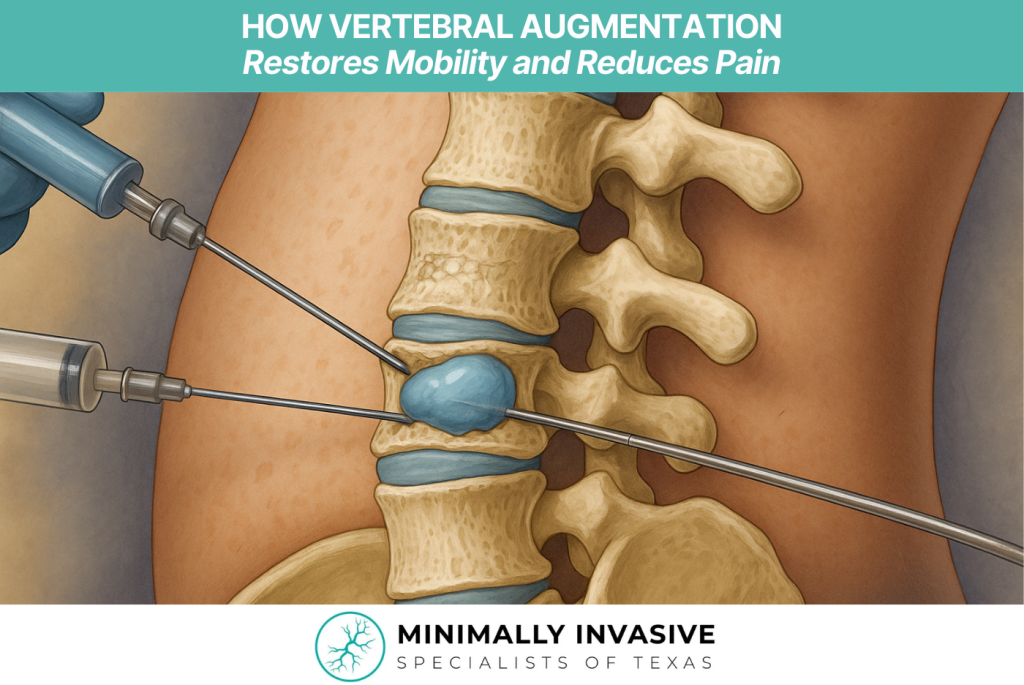
Vertebral augmentation is an umbrella term for procedures such as kyphoplasty and vertebroplasty. Both involve inserting a medical-grade cement into a fractured vertebral body to stabilize the bone and prevent further collapse. Kyphoplasty adds a balloon step to gently restore vertebral height before the cement is injected.
Conditions Treated
- Osteoporotic Compression Fractures: Most common, caused by weakened bones.
- Metastatic Cancer Lesions: Tumor-related fractures.
- Traumatic Fractures: When surgery isn’t an option or to support healing.
Benefits
- Rapid pain relief—often within 24–48 hours
- Improved spinal stability and posture
- Enhanced mobility and reduced dependence on pain medication
- Outpatient procedure with small incisions and minimal recovery time
The Procedure: What to Expect
- Evaluation & Imaging – MRI or CT confirms the fracture and ensures candidacy.
- Local Anesthesia & Mild Sedation – Patients remain comfortable and relaxed.
- Needle Placement – Using fluoroscopic (X-ray) guidance, a tiny needle enters the fractured vertebra.
- Cement Injection – Medical-grade bone cement is carefully injected, hardening within minutes.
- Recovery – Most patients walk out the same day and resume light activities within 24 hours.
Recovery & Outcomes
Patients typically notice significant pain reduction within days. Light activity is encouraged soon after the procedure, though strenuous lifting should be avoided for at least a week. Follow-up imaging ensures proper healing and alignment.
Comprehensive Q&A
Q: Who is a good candidate for vertebral augmentation?
A: Individuals with painful vertebral compression fractures—especially those from osteoporosis—who have not responded to conservative treatments like bracing or medications are ideal candidates.
Q: How soon will I feel pain relief?
A: Many patients experience noticeable relief within 24 to 48 hours.
Q: Is the procedure safe?
A: Yes. Complications are rare, especially when performed by experienced interventional radiologists. We use real-time imaging to ensure precision.
Q: Will insurance cover it?
A: Most insurance plans, including Medicare, cover vertebral augmentation when medically necessary.
Q: How long does the procedure take?
A: Typically 45–60 minutes, with a short recovery observation period afterward.
Q: Can multiple vertebrae be treated?
A: Yes, if needed, more than one vertebra can be treated in a single session after a thorough evaluation.
Why Choose Minimally Invasive Specialists of Texas
Our Pasadena team specializes in image-guided spinal procedures, combining cutting-edge technology with personalized care. We focus on swift pain relief, fast recovery, and helping you regain independence.
Contact Us Today
Minimally Invasive Specialists of Texas
4003 Woodlawn Ave
Pasadena, TX 77504
Phone: (832) 583-2246
Call today to schedule a consultation and learn how vertebral augmentation can help you move freely again.
Key Takeaways
- Vertebral augmentation stabilizes spinal fractures and provides rapid pain relief.
- Minimally invasive techniques mean small incisions and fast recovery.
- Expert care in Pasadena, TX ensures safe, effective treatment tailored to you.