
By Minimally Invasive Specialists of Texas
Understanding BPH and Why It Matters
Benign Prostatic Hyperplasia (BPH) is a non-cancerous enlargement of the prostate gland that can make urination difficult and disrupt daily life. Common symptoms include frequent nighttime urination, weak urine flow, or the feeling of incomplete emptying of the bladder. Traditionally, surgical procedures like a transurethral resection of the prostate (TURP) or even open surgery were used to relieve these symptoms.
Today, Prostate Artery Embolization (PAE) offers a modern, minimally invasive alternative that treats BPH without the need for major surgery.
What Is Prostate Artery Embolization (PAE)?
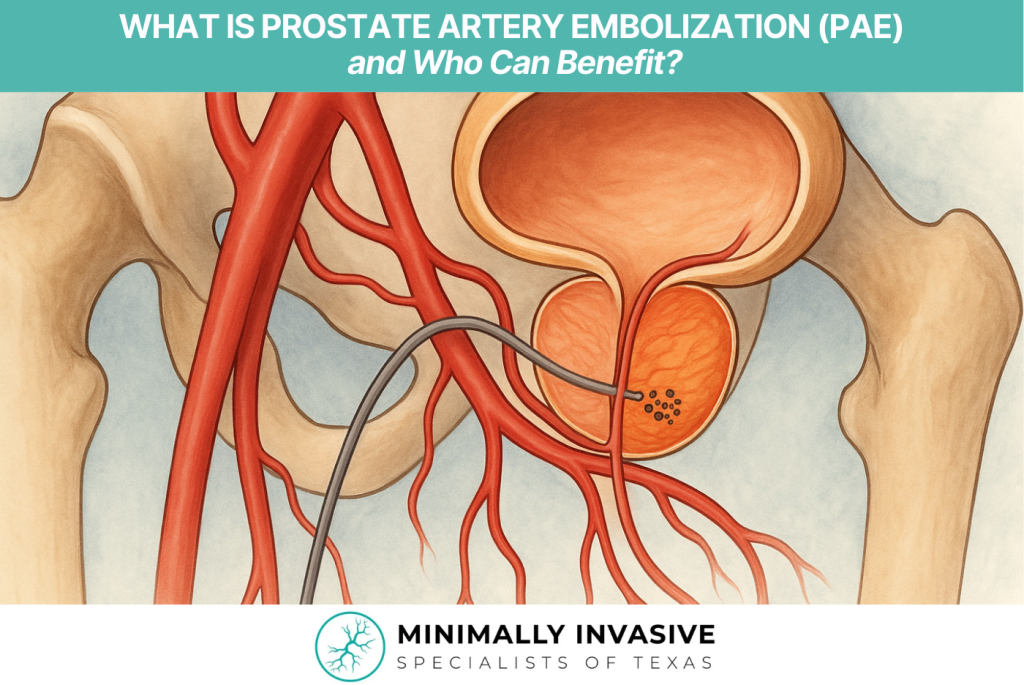
PAE is an image-guided, outpatient procedure performed by an interventional radiologist. Using X-ray imaging, a small catheter is threaded through an artery in the wrist or groin to the arteries supplying blood to the prostate. Tiny particles are then released to block these arteries, reducing blood flow and causing the prostate to shrink over time.
Key Advantages:
- Minimally Invasive: No surgical incision.
- Quick Recovery: Most patients go home the same day.
- Lower Risk: Less chance of sexual side effects compared to surgery.
- Effective Relief: Significant improvement in urinary symptoms, often within weeks.
Who Is a Candidate for PAE?
PAE may be a good choice if you:
- Have moderate to severe BPH symptoms.
- Prefer to avoid traditional surgery or cannot tolerate anesthesia.
- Want to preserve sexual function.
- Have tried medications without relief or had side effects.
It’s important to have a full evaluation—including imaging and a consultation with an interventional radiologist—to confirm whether PAE is right for you.
Benefits of Choosing PAE
- Comfortable Procedure: Local anesthesia and conscious sedation.
- Outpatient Care: Most patients resume normal activities within a few days.
- Fewer Complications: Lower risk of incontinence or erectile dysfunction.
Comprehensive Q&A
Q: How long does the PAE procedure take?
A: Usually 1.5 to 2 hours, including preparation and recovery.
Q: Will I feel pain during PAE?
A: Most patients feel only mild discomfort, thanks to local anesthesia and light sedation.
Q: How soon will I notice improvement?
A: Some men experience relief within days, while full benefits often appear over several weeks to months as the prostate gradually shrinks.
Q: Is PAE covered by insurance?
A: Many insurance plans, including Medicare, now cover PAE. Our team can help verify your specific benefits.
Q: Are there any risks?
A: As with any medical procedure, there are small risks such as minor bleeding or infection, but serious complications are rare.
Q: Will PAE affect sexual function?
A: PAE has a lower risk of erectile dysfunction and retrograde ejaculation compared to surgical treatments.
Why Choose Minimally Invasive Specialists of Texas
Our board-certified interventional radiologists use state-of-the-art imaging and advanced techniques to provide personalized BPH care. We focus on patient comfort, safety, and the fastest possible recovery.
Contact Us
Minimally Invasive Specialists of Texas
4003 Woodlawn Ave
Pasadena, TX 77504
Phone: (832) 583-2246
Take the first step toward relief from BPH symptoms. Call today to schedule your consultation and find out if PAE is right for you.